By Procon Project Manager Casey Cloonan, CCM, CAPM, LEED Green
With the successful return of Artemis II earlier this month, attention now turns to what comes next—ushering in a new chapter of lunar exploration and redefining what’s possible in human spaceflight.
The world watched as a powerful rocket carried four brave astronauts farther than any crew in decades. Less visible, however, were the years of preparation for that moment, the complex infrastructure modernizations required to make the mission not just possible, but safe.
That’s where Procon came in.
To support the series of critical upgrades, Procon deployed specialized teams across Kennedy Space Center (KSC), each led by deeply-experienced professionals who helped ready NASA’s infrastructure for Artemis II. From historic structures to essential launch infrastructure, these efforts formed a quiet but indispensable foundation for the Artemis II mission.
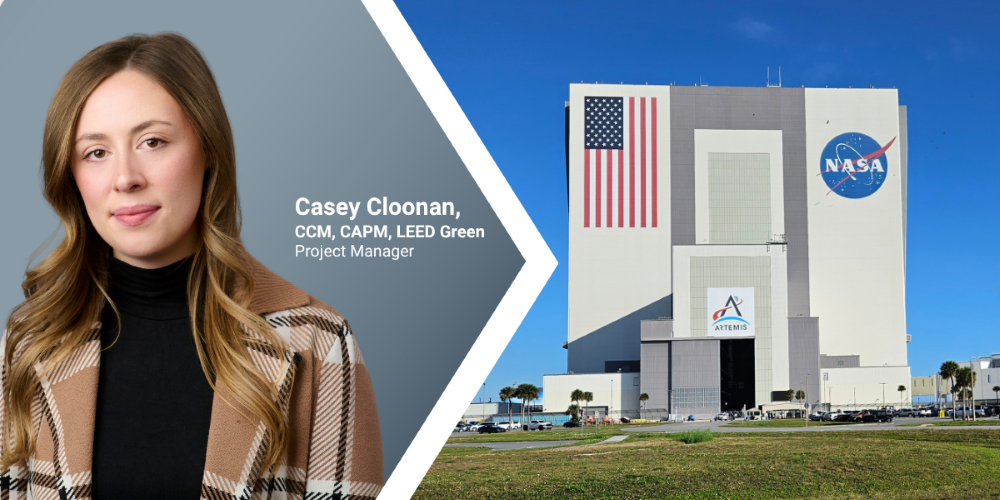
In the Vehicle Assembly Building (VAB)—one of the most iconic structures in space exploration—Procon’s Olga Larina, CCM, PMP, CQM served as the lead, bringing her expertise in structural engineering to guide design and construction management. Under her leadership, the team reinforced the building’s steel framework to support new Space Launch System (SLS) platforms, ensuring the rocket could be safely stacked for launch.
Just steps away from the spotlight, modernization efforts were also underway in the Operations & Checkout Building, where astronauts quarantine prior to launch and the Orion spacecraft undergoes critical testing. Leading this effort was Procon’s Darren Stutzke, who brought deep technical expertise as a master electrician to the project. Under his leadership, the facility’s electrical distribution system, largely unchanged since the 1960s, was upgraded to meet the demands of modern spaceflight.
At Launch Complex 39B, the work turned even more technical. Procon supported the installation and repair of critical cryogenic systems, including liquid nitrogen and liquid hydrogen infrastructure. These systems are essential to launch safety—stabilizing conditions and enabling the secure handling of highly volatile fuels that power the rocket. Following damage from Artemis I, the liquid hydrogen system required careful upgrades and rigorous oversight to ensure it was fully mission-ready, with Procon Project Manager Emily Sullivan, CCM, PMP providing in-depth design compliance checks on the new LH2 system.
And while the launch pad often captures attention, essential work was also happening upstream. At the Booster Fabrication Facility, where Northrop Grumman manufactures the SLS boosters, Procon supported facility upgrades that improved core systems like HVAC and water infrastructure—helping ensure reliable production of the hardware that makes liftoff possible.
As the Program and Project Manager that led our team of construction managers, quality assurance inspectors, and project engineers at Kennedy Space Center, I remain in awe of the dedication to the NASA mission that this team displayed daily. Thank you to Kristin Vranicar, CCM, EIT, CQM, for her executive leadership across these projects. Josh Christoffersen and Suresh Rajagopalan also contributed their critical expertise across the entire KSC portfolio, with Josh providing overall CM support and Suresh overseeing and tracking the schedule in alignment with mission timelines.
Individually, these efforts may go unnoticed. Together, they form the foundation of a successful and safe mission.
Artemis II highlights both the extraordinary courage of the crew and the critical role of the systems that support them. Procon is proud to have contributed to the safe, reliable infrastructure that enables missions of this scale.